How virtual reality improves student learning by creating immersive experiences that boost engagement, memory, and real-world skills in fun, interactive ways.
Virtual reality improves student learning by creating immersive environments that make complex concepts easier to understand, increase engagement, and enhance memory retention through interactive, hands-on experiences.
How Virtual Reality Improves Student Learning 🎓
Have you ever wished school could feel more like an adventure instead of just another day in class? Well, virtual reality (VR) is turning that dream into reality—literally. 🕶️
Virtual reality is changing how students learn by allowing them to step inside the lesson instead of just reading about it. Imagine exploring ancient Rome, diving into the ocean, or walking through the human body—all without leaving your classroom. That’s the power of VR in education.
Let’s break down how VR is reshaping the classroom experience and why it’s becoming one of the most exciting tools in modern learning.
Understanding Virtual Reality In Education 🧠
Virtual reality in education refers to using computer-generated simulations that let students interact with 3D environments. These experiences make learning feel hands-on and personal.
Unlike traditional methods, where students passively read or listen, VR turns them into active participants. They can explore, experiment, and even make mistakes safely—something textbooks can’t offer.
The Growing Role Of VR In Modern Classrooms
Schools across the U.S. are quickly adopting VR technology. From elementary classrooms to college labs, educators are discovering how VR boosts student curiosity and retention.
According to education reports, over 70% of teachers believe VR enhances learning engagement. And as VR headsets become more affordable, even small schools can now join the trend.
Why Virtual Reality Improves Student Learning
The main reason VR works so well is because it makes learning feel real. When students can see, touch, and experience content, their brains store information more effectively.
💡 Simply put: VR moves learning from memorization to immersion. That shift makes lessons stick longer and spark genuine curiosity.
Boosting Student Engagement Through Immersion 🎮
Let’s be honest—keeping students’ attention is tough. But VR captures their focus in seconds.
When learners wear VR headsets, distractions fade away. They’re fully absorbed in the scene—solving problems, observing reactions, or exploring new worlds. This sense of immersion boosts focus, motivation, and participation.
Key Benefits Of Immersive Engagement:
- Increases classroom enthusiasm
- Reduces boredom and distractions
- Encourages curiosity and self-driven exploration
Making Complex Subjects Easier To Understand
Subjects like physics, biology, or history often feel abstract. But VR transforms these topics into visual experiences that are easier to grasp.
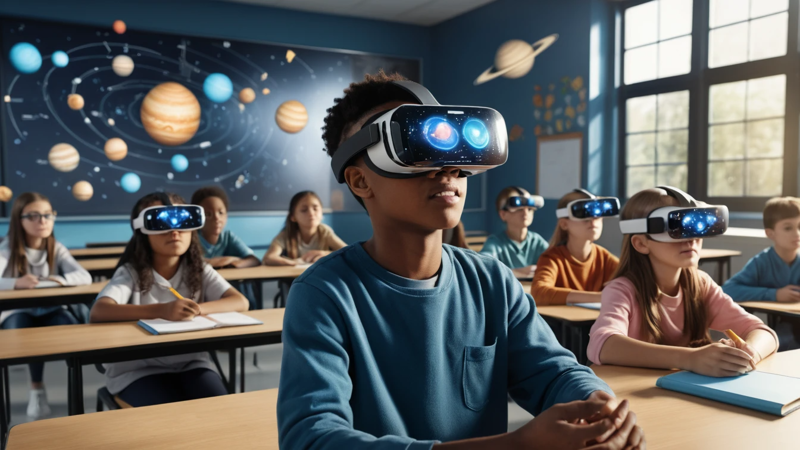
Instead of memorizing molecules, students can walk inside a cell. Instead of reading about space, they can float among planets. This 3D visualization helps connect theory with practice, making abstract ideas tangible.
How VR Simplifies Difficult Subjects
| Subject Area | Traditional Learning Challenge | VR-Based Learning Advantage |
| Chemistry | Hard to visualize molecular structures | Explore 3D molecular models interactively |
| History | Text-heavy and hard to imagine | Walk through historical events in real time |
| Math | Abstract formulas | Visualize geometry and data in 3D space |
Encouraging Collaboration And Social Learning 👥
VR isn’t just for solo experiences—it’s great for teamwork too! Students can meet in shared virtual spaces, collaborate on projects, and solve group challenges.
These collaborative VR environments improve communication and build soft skills like leadership and problem-solving. It’s like a group field trip—only digital.
Improving Memory Retention And Recall
Studies show that people remember 90% of what they do compared to only 10% of what they read. Since VR involves active participation, it creates stronger memory links.
When students experience a concept in 3D, their brains store it as a real event. Later, recalling that lesson feels natural and effortless.
Creating A Safe Learning Environment 🛡️
Not all lessons can be practiced safely in the real world—like performing surgery, fighting fires, or flying planes. But VR allows students to train in risk-free, simulated environments.
This hands-on learning lets them gain experience without danger or cost. Mistakes become opportunities, not failures.
Bridging The Gap Between Theory And Practice
Many students struggle to connect classroom lessons to real-life applications. VR bridges that gap by bringing theory into practice.
For example, a medical student can practice anatomy virtually before entering a real operating room. Engineering students can test designs in 3D before building prototypes. That’s powerful, career-ready learning. 💪
Real-World Applications Of VR Learning
| Field | How VR Is Used | Learning Outcome |
| Medicine | Virtual surgeries and anatomy simulations | Better precision and confidence |
| Architecture | Virtual building walkthroughs | Improved spatial understanding |
| Environmental Science | Climate change visualizations | Greater awareness and problem-solving |
Making Education More Accessible 🌍
VR removes physical and geographical barriers. A student in a small town can now “visit” the Louvre, explore Mars, or attend global seminars without leaving their desk.
This accessibility means everyone—regardless of location—can experience world-class education. It levels the playing field for all learners.
Catering To Different Learning Styles
Every student learns differently. Some are visual, others auditory, and some kinesthetic. VR adapts beautifully to all these styles.
It blends visual storytelling, sound, and movement, ensuring no one is left behind. That personalized experience improves understanding and reduces learning frustration.
Motivating Students With Gamified Learning 🎯
Gamification—adding fun, reward-based elements—makes VR even more effective. When learning feels like a game, students stay motivated longer.
They earn badges, complete missions, and solve puzzles—all while learning valuable concepts. This blend of fun and education transforms classrooms into active learning zones.
Developing Empathy And Global Awareness 🌐
VR isn’t just about science or history—it also builds empathy. Students can virtually experience life from another person’s perspective, deepening understanding and compassion.
Whether it’s exploring another culture or witnessing environmental issues firsthand, VR opens young minds to the world beyond their walls.
Emotional And Social Impact Of VR Learning
| VR Experience Type | Skill Developed | Educational Impact |
| Cultural Simulations | Empathy & Awareness | Broader worldview |
| Team Collaboration | Communication | Stronger teamwork |
| Story-Based Learning | Emotional Connection | Better memory and understanding |
Reducing Learning Anxiety And Boosting Confidence 😌
Traditional learning can feel intimidating—especially during tests or presentations. VR creates low-pressure environments where students can practice freely and learn from mistakes without embarrassment.
Over time, this builds confidence and self-efficacy, helping even shy students participate more actively.
Preparing Students For Future Careers
Today’s job market demands digital skills, critical thinking, and adaptability. VR prepares students for this by simulating real-world work scenarios.
From virtual job interviews to industrial simulations, VR training gives learners a career advantage before they even graduate.
Challenges And The Road Ahead
Of course, VR isn’t perfect yet. The technology still faces challenges like equipment cost, teacher training, and accessibility.
But as tech becomes more affordable and user-friendly, these barriers will fade. The future classroom will likely combine AI, VR, and AR for a richer, more interactive experience.
Conclusion: A New Era Of Learning Awaits 🚀
Virtual reality is not just a gadget—it’s a gateway to better learning. By making education immersive, interactive, and inclusive, VR empowers students to see, feel, and experience knowledge like never before.
From improving focus and memory to building empathy and confidence, VR is transforming education one headset at a time. The classroom of tomorrow? It’s already here.
FAQs About Virtual Reality And Student Learning
- How does virtual reality help students learn faster?
VR helps students learn faster by turning lessons into interactive experiences. It increases focus, makes information easier to remember, and helps students understand complex ideas visually. - Can VR replace traditional teaching methods?
Not completely. VR works best as a supplement to traditional methods. It enhances lessons, but human interaction and discussion remain essential in education. - What subjects benefit most from VR learning?
Science, history, and engineering benefit the most. These subjects involve complex or abstract concepts that become easier to grasp through visual and hands-on VR experiences. - Is virtual reality learning safe for students?
Yes, VR learning is safe when used in moderation. Most headsets are designed for short sessions, and teachers monitor usage to prevent eye strain or fatigue. - How can schools afford VR technology?
Many schools start with small pilot programs or use shared devices. As technology advances, prices continue to drop, making VR more accessible every year.