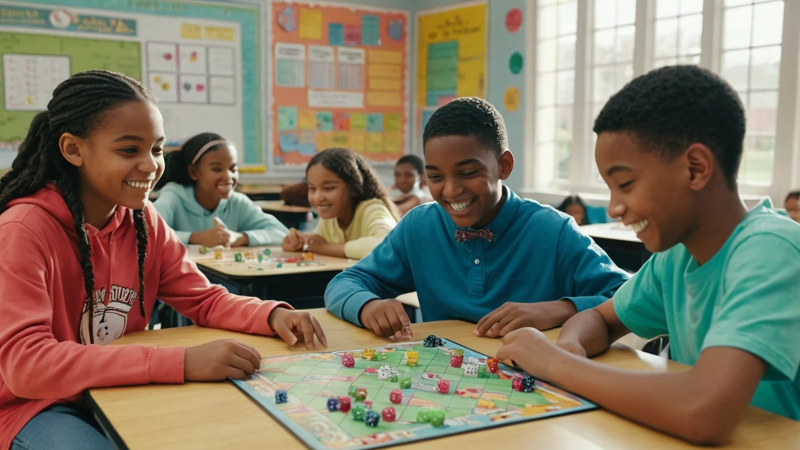
Fun math games for middle school that make learning exciting, improve skills, and keep students engaged in class or at home.
Fun math games for middle school are interactive activities that help students practice math skills through play. They boost engagement, improve problem-solving, and reduce math anxiety. These games work in classrooms, small groups, or at home. Best of all, they make math feel less scary and more fun.
Have you ever noticed how students light up during game time—but freeze during math time? What if you could combine both?
Here’s the good news: fun math games for middle school can turn boring worksheets into exciting challenges. They help students practice fractions, algebra, geometry, and problem-solving without feeling overwhelmed. When learning feels like play, students stay focused longer. And yes, they actually remember more.
Why Fun Math Games Matter In Middle School 🧠
Middle school is where math gets serious. Students move from basic arithmetic to algebra and geometry. That shift can feel huge. Many students start losing confidence during these years.
Games change that experience. They reduce stress and build confidence. When students compete or collaborate, they forget their fear of getting answers wrong. Instead, they focus on solving problems.
Math games create a safe space to try, fail, and try again. That mindset builds resilience. And resilience matters more than speed.
Benefits Of Using Interactive Math Games 🎯
Interactive math games are not just “extra fun.” They serve a real purpose. They improve retention and understanding. Students learn by doing, not just listening.
Here’s what makes them powerful:
- Improve critical thinking skills
- Encourage teamwork
- Increase classroom participation
- Reduce math anxiety
- Strengthen memory through repetition
When students enjoy practice, they practice more. And more practice leads to mastery. It’s that simple.
Quick Comparison Of Game Types And Skills Practiced
| Game Type | Skills Practiced | Best For |
| Card Games | Fractions, Integers | Small Groups |
| Board Games | Strategy, Probability | Classrooms |
| Digital Games | Algebra, Geometry | Independent Practice |
| Movement Games | Mental Math | Active Learners |
Different games support different learning styles. Some students prefer digital tools. Others thrive with hands-on activities. Mixing formats keeps everyone engaged.
Math Bingo With A Twist 🎉
Math Bingo is a classic. But you can level it up. Instead of calling out answers, call out problems. Students solve the equation before marking their board.
This works great for:
- Integer operations
- Decimal practice
- Algebra basics
Add small rewards for winners. Or let winners become the next caller. Suddenly, everyone wants to solve faster.
Fraction War Card Game 🃏
Grab a deck of cards. Each player flips two cards to create a fraction. The larger fraction wins the round. Simple, right?
This game builds fraction comparison skills. It also improves mental math speed. You can modify it for decimals or percentages.
Students don’t even realize they’re practicing. They just want to win. That competitive spark drives learning.
Math Escape Room Challenge 🔐
Escape rooms are wildly popular. Why not bring one into your classroom? Create puzzles that require solving equations or word problems.
Students work in teams. Each correct answer unlocks the next clue. The goal is to “escape” before time runs out.
This activity builds:
- Problem-solving
- Collaboration
- Logical reasoning
The excitement in the room is real. And the learning sticks.
Around The World Math Game 🌍
This fast-paced game builds mental math speed. Two students stand. The teacher gives a problem. The first to answer correctly moves on.
It works best for:
- Multiplication facts
- Integer operations
- Quick equations
Keep the tone friendly. Encourage effort over speed. The goal is confidence, not pressure.
Digital Math Games For Middle School 💻
Technology can be powerful when used wisely. Many interactive math games online adapt to student levels. That keeps challenges balanced.
Digital games are great for independent practice. They also provide instant feedback. Students see mistakes immediately and correct them.
Just remember balance. Screen time should support learning, not replace hands-on interaction.
Board Games That Teach Math Strategy ♟️
Board games teach more than rules. They build logical thinking. Games involving probability or scoring systems reinforce math skills naturally.
Consider creating custom math board games. Students move forward by solving problems. Add challenge cards for extra fun.
Here’s a simple idea:
| Board Game Style | Math Skill | Fun Element |
| Dice Roll Race | Probability | Surprise Moves |
| Equation Quest | Algebra | Power Cards |
| Geometry Path | Angles | Bonus Points |
Learning feels adventurous instead of routine.
Real-Life Math Scavenger Hunt 🔎
Want movement and math together? Try a scavenger hunt. Hide problems around the classroom or school. Each answer leads to the next clue.
This works well for:
- Geometry measurements
- Percent calculations
- Word problems
Students love the active element. It turns math into a mission.
Math Jeopardy Review Game 📺
Jeopardy-style games work perfectly for test review. Divide the board into categories. Assign different point values.
Categories could include:
- Fractions
- Algebra
- Geometry
- Word Problems
Students choose their challenge level. Higher points mean harder questions. The format keeps everyone involved.
Mystery Number Logic Game 🕵️
Choose a secret number. Give clues using math operations. Students must solve the puzzle step by step.
For example:
- It’s greater than 20
- It’s divisible by 5
- It’s less than 40
This builds logical reasoning. It also strengthens number sense.
Dice And Probability Games 🎲
Dice games are simple but powerful. Roll two dice and create equations. Or predict outcomes based on probability.
Students quickly understand concepts like:
- Likelihood
- Outcomes
- Ratios
They learn probability by experiencing it. That hands-on practice makes abstract ideas clearer.
Group Problem-Solving Relay Race 🏃
Divide students into teams. Each member solves one step of a multi-step problem. Then they pass it on.
This builds:
- Collaboration
- Accountability
- Multi-step reasoning
It also keeps energy high. Movement increases focus and memory retention.
Math Puzzles And Brain Teasers 🧩
Brain teasers stretch thinking. They require patience and creativity. Students must analyze patterns or hidden clues.
Examples include:
- Magic squares
- Logic grids
- Number riddles
These puzzles build deep thinking skills. They also prepare students for advanced math challenges.
Comparing Traditional Practice Vs Game-Based Learning
| Traditional Practice | Game-Based Learning |
| Worksheets | Interactive Play |
| Passive Learning | Active Engagement |
| Individual Work | Team Collaboration |
| Anxiety Focused | Confidence Building |
Games do not replace instruction. They enhance it. When combined with teaching, they create balanced learning.
Tips For Choosing The Right Math Games ✅
Not all games fit every class. Consider your students’ skill levels. Choose games aligned with learning goals.
Here’s how to pick wisely:
- Match games to current topics
- Keep instructions simple
- Set clear time limits
- Encourage teamwork
- Reflect after playing
Reflection is key. Ask students what they learned. That reinforces understanding.
How To Keep Math Games Educational And Fun 🎈
Fun is important. But learning must remain the focus. Set clear objectives before starting any game.
Avoid games that rely only on speed. Focus on accuracy and reasoning. Praise effort, not just winning.
Remember this: “When students enjoy the process, success follows naturally.”
Balance excitement with structure. That’s the sweet spot.
Conclusion: Turning Math Into An Adventure 🚀
Fun math games for middle school transform learning. They reduce stress and increase engagement. Students practice skills without feeling pressured. Confidence grows with every challenge.
Middle school math does not have to feel overwhelming. With interactive math activities, classrooms become lively and positive spaces. When students laugh, compete, and collaborate, they learn deeply.
Math becomes less about fear and more about discovery. And that shift changes everything.
FAQs
What Are Easy Math Games For Middle School Classrooms?
Simple games like Math Bingo or Fraction War work well. They require little preparation. They also reinforce core math skills effectively.
How Do Fun Math Games Help Struggling Students?
Games reduce pressure and increase confidence. Students feel safe making mistakes. That builds stronger understanding over time.
Can Math Games Replace Traditional Worksheets?
Games should support instruction, not replace it. They reinforce concepts in engaging ways. A balanced approach works best.
What Are Good Math Review Games Before Tests?
Jeopardy-style reviews and escape rooms are excellent. They cover multiple topics quickly. Students stay focused and motivated.
How Often Should Teachers Use Math Games?
Use them weekly or during review sessions. Consistency keeps students engaged. Balance ensures steady academic growth.